

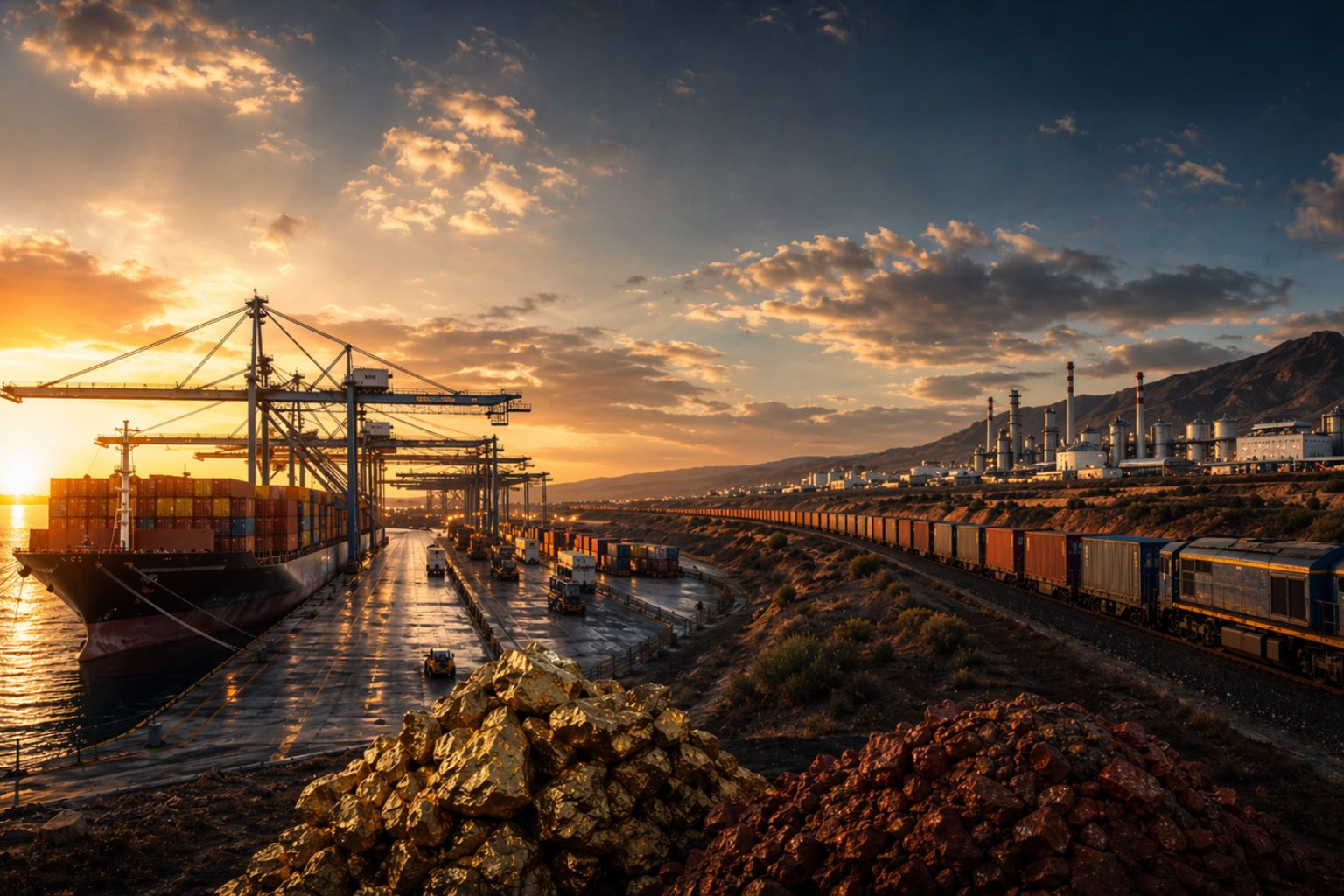
Where Africa’s Most Credible Supply Opportunities Are Emerging
Africa is not short of opportunity. It is short of people willing to separate the real from the romantic.
A Tougher Backdrop
That matters more now than ever. The external backdrop is harder than many expected. On April 8, 2026, the World Bank cut its Sub-Saharan Africa growth forecast for 2026 from 4.4% to 4.1%, citing higher fuel and fertiliser costs, tighter investment conditions and already-stretched public finances. In a market like that, credible opportunities do not emerge because a country has reserves on paper but emerge when policy, logistics, counterparties and urgency begin moving in the same direction. (Reuters)
That is the lens through which we think the African market should be viewed.
Not “where are the biggest deposits?”
Not “which country is making the most noise?”
Not even “where is everyone else looking?”
The better question is this: where is supply becoming formal, financeable and executable and where can we access the governments, institutions and private-sector partners that bring real leverage to that process?
That is where the most credible opportunities tend to emerge, not simply where resources exist, but where the right public and private relationships are beginning to give those resources shape, direction and commercial force.
Ghanaian Gold
One of the clearest answers right now is Ghanaian gold. In February 2026, Ghana said it wanted to channel roughly 127 metric tonnes of artisanal and small-scale gold each year into official trade, with GoldBod required to buy at least 2.45 tonnes a week and consolidate those purchases into a formal pipeline targeting more than $20 billion of annual inflows. The state’s ambition is not subtle: tighter traceability, more refining capacity, lower operating costs, centralised offtake negotiation and more control over where the value lands. Whatever view one takes on the politics of it, the direction of travel is obvious. Ghana wants a larger share of the gold value chain inside a more formal structure.
That matters not only for the sector itself, but for the wider economy. In 2025, stronger gold revenues and the state’s expanding gold-purchase framework helped support the cedi, which at one stage had risen more than 40% against the dollar, easing the local-currency burden of Ghana’s foreign debt and giving the government more fiscal breathing room. Gold purchases also helped build reserves, while wider debt restructuring and IMF support reduced near-term debt service pressure. In practical terms, that gives Ghana a better platform in 2026 to pay down the legacy of its crisis, stabilise the macro picture and improve the government’s ability to execute. And that is really the point: when a country uses a strategic commodity not just to export volume, but to strengthen its currency, rebuild reserves and restore room for action, that is when supply opportunity starts to become much more credible.
Markets pay attention when a jurisdiction moves from rhetoric to mechanism. That same story was reinforced again on April 9, 2026, when Trafigura signed its first deal in Ghana’s gold sector, agreeing to buy 700,000 ounces from Bogoso-Prestea and provide $65 million of debt financing to support the restart of the mine’s oxide operations. This materially matters because it is not just another headline about gold being in the ground, it is an international trading house stepping into a transaction with finance, offtake and a restarted operating asset in a market that is actively trying to formalise and localise participation. That is what credibility looks like in practice. (Reuters)
Copperbelt and Corridors
The second area worth serious attention is the Copperbelt and, more importantly, the corridors around it. Zambia said in March 2026 that it wants to more than triple copper output to 3 million metric tonnes by 2031 from 890,346 tonnes last year. That alone would be material. But the wider signal is stronger still: capital is coming in, governments are actively courting investors and projects such as KoBold Metals’ Mingomba development are now moving from concept toward build-out, with a stated target of 300,000 tonnes of annual copper production in the early 2030s. This is not theoretical critical-minerals chatter anymore, it is a live race to secure long-term copper supply. (Reuters)
What many people still miss, however, is that the best opportunities around copper are not always in the copper itself. They are often in the chain that allows copper to move.
Over the last few days alone, Reuters reported that trains through Angola’s Lobito corridor a vital route for copper and cobalt were suspended by flooding, while miners in the DRC were simultaneously cutting chemical use because Middle East-linked shipping disruption hit supply of essential leaching inputs such as sulfuric acid and sodium metabisulfite. Premiums on those chemicals moving through Dar es Salaam had almost doubled and buyers had tightened physical verification protocols, with some now insisting on checking inventories and title documentation before committing. In plain English: the market is not only buying metal, it is pricing access, reliability, route optionality and proof of stock. That is where a great deal of real margin sits. (Reuters)
Guinea and Infrastructure Shift
Then there is Guinea, which for years sat in many boardroom conversations as a geological giant and an execution headache. That equation is beginning to change. Reuters reported in January 2026 that China’s Baowu had taken control of the operator for Simandou Blocks 1 and 2, with the project’s shared rail and port infrastructure already having enabled initial iron ore shipments in November 2025. At full run-rate, Simandou is designed to ship up to 120 million metric tonnes of high-grade iron ore a year. That is enormous, but the deeper point is that Guinea is no longer only a conversation about what might one day happen. Large-scale mining and infrastructure are now materially under way, and when infrastructure of that scale starts moving, it tends to create a much wider field of opportunity around logistics, services, local partnerships, supply agreements and associated industrial development. (Reuters)
Energy Back on the Board
Energy is also quietly shifting from “one day” to “back on the board”. In Mozambique, TotalEnergies relaunched its $20 billion LNG project in January 2026, with first LNG targeted for 2029 and production capacity of 13 million tonnes a year. In Tanzania, the government said in January it expected to sign a deal for its $42 billion LNG plant before June, with production forecast to begin in eight years. Neither of these is tomorrow morning’s cargo. But both are examples of something important: projects that had slipped into the category of “permanent maybe” are moving back into structured timetables with real counterparties, real budgets and real geopolitical weight behind them. For anyone serious about medium-term African supply, that really matters. (Reuters)
What This Means
What ties all of these markets together is not simply resource abundance. Africa has always had that. What is changing is where resource potential is being converted into formal channels, infrastructure, bankable counterparties and routes to offtake.
That is the part that interests us most.
Because the truth is that credible African supply opportunities rarely fail for lack of commodity. They fail because people enter too early, too loosely or too blindly. They confuse access with execution. They mistake a meeting for a route to supply. They hear “government backed” and assume the difficult work is done, in reality, that is usually where the difficult work begins.
This is also why we believe the real value in frontier markets is not just in finding opportunity. It is in identifying which opportunity is actually actionable, who genuinely controls access to it, what structure can make it bankable and what has to be solved on the ground before the market sees it clearly.
In other words, the opportunity itself is only half the story. The other half is getting inside it early enough, credibly enough and intelligently enough to turn it into something real.
And that is exactly where Africa’s most credible supply opportunities are emerging now.